
Concept information
Terme préférentiel
Lagrange's four-square theorem
Définition
-
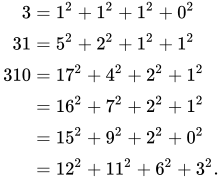
Lagrange's four-square theorem, also known as Bachet's conjecture, states that every natural number can be represented as a sum of four non-negative integer squares. That is, the squares form an additive basis of order four. where the four numbers are integers. For illustration, 3, 31, and 310 in several ways, can be represented as the sum of four squares as follows:This theorem was proven by Joseph Louis Lagrange in 1770. It is a special case of the Fermat polygonal number theorem.
(Wikipedia, The Free Encyclopedia, https://en.wikipedia.org/wiki/Lagrange%27s_four-square_theorem)


Concept générique
Synonyme(s)
- Bachet's conjecture
Traductions
-
français
-
conjecture de Bachet
URI
http://data.loterre.fr/ark:/67375/PSR-RD62G3Z9-J
{{label}}
{{#each values }} {{! loop through ConceptPropertyValue objects }}
{{#if prefLabel }}
{{/if}}
{{/each}}
{{#if notation }}{{ notation }} {{/if}}{{ prefLabel }}
{{#ifDifferentLabelLang lang }} ({{ lang }}){{/ifDifferentLabelLang}}
{{#if vocabName }}
{{ vocabName }}
{{/if}}