
Concept information
Término preferido
Stanley symmetric function
Definición
-
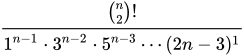
In mathematics and especially in algebraic combinatorics, the Stanley symmetric functions are a family of symmetric functions introduced by Richard Stanley (1984) in his study of the symmetric group of permutations. Formally, the Stanley symmetric function Fw(x1, x2, ...) indexed by a permutation w is defined as a sum of certain fundamental quasisymmetric functions. Each summand corresponds to a reduced decomposition of w, that is, to a way of writing w as a product of a minimal possible number of adjacent transpositions. They were introduced in the course of Stanley's enumeration of the reduced decompositions of permutations, and in particular his proof that the permutation w0 = n(n − 1)...21 (written here in one-line notation) has exactly
(Wikipedia, The Free Encyclopedia, https://en.wikipedia.org/wiki/Stanley_symmetric_function)

Concepto genérico
En otras lenguas
-
francés
URI
http://data.loterre.fr/ark:/67375/PSR-QRR42L58-B
{{label}}
{{#each values }} {{! loop through ConceptPropertyValue objects }}
{{#if prefLabel }}
{{/if}}
{{/each}}
{{#if notation }}{{ notation }} {{/if}}{{ prefLabel }}
{{#ifDifferentLabelLang lang }} ({{ lang }}){{/ifDifferentLabelLang}}
{{#if vocabName }}
{{ vocabName }}
{{/if}}